Celebrating over 30 years as an arts organization.


The Center hosts readings, workshops, lectures, and publishes a variety of poetry publications. SPC is located in the R25 Arts Complex located on the corner of R & 25th Streets in midtown Sacramento.


Sacramento Poetry Center memberships support a variety of local poetry programs, publications, readings, and events. Members receive a free subscription to Tule Review and Poetry Now. Please send your check for $30 or more to SPC, 1719 25th St., Sacramento, CA 95816. Fixed incomes are $15.


Tuesday, September 23, 2008

Robert Grossklaus and Litany—Sept. 22, 2008

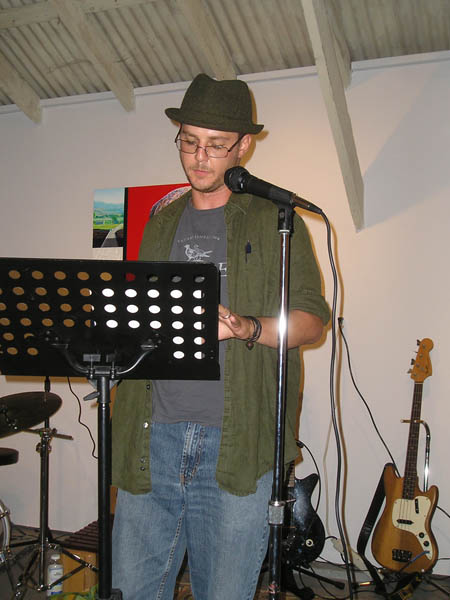
The Sacramento Poetry Center forged music and words together in its word foundry on Mon. Sept. 22. The principal smithies were Robert Grossklaus who started off the evening by reading

Prairie Creek

Poetry across the sky,
rippling softly over cement,
words meandering
their way east wind.
Afternoons melt into
hot breath, slight,
like the movement of water uphill,
more than a reflection.
waiting for the music . . .

Granite, rivers of milk
snaking their way between buildings
of imagination and institution,
towering above mortality,
crushing magnitude,
sun caking concrete
against thought, erecting walls
of spoiled earthways—
eat these meanings
and regurgitate them
into the mouths of children.

The words eschewing from still lips, breathless;
foreboding softly somewhat fierce,
focused on the becoming.
You become the target.

This is not a lament, it’s a battlecry!

Our hearts beat their way through bony prisons,
bursting outward into the dead;
the chains our restitution
for moments unbridled.
We dance toward the sun across the blood of others.
In this dream we are awake and we are unafraid.

Persist through glaciers of encumbered thought,
chip away or crash through,
the cracks and fissures are hope.
through weariness, through stagnant waters,
through the myriad of sorrow, through
the black sunsets of cold habituation—
create the catharsis, a sacred chalice filled
the blood and spit of those who’ve failed,
fallen in your wake,
swallowed up by mirrors and ephemera.

Sing those songs you never thought you could!


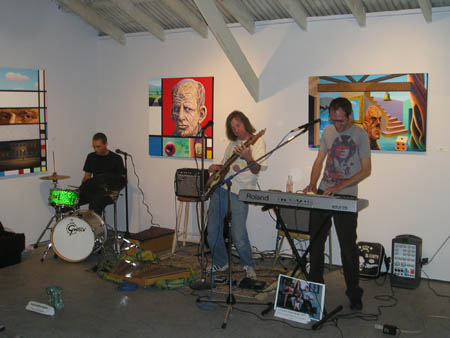
Grossklaus was joined by Litany [Chéne Watson on percussion, Bob Wilson on guitars (and King Crimson t-shirt) and Miles Miniaci on keyboards and vocals]. While overseen by the paintings of Dan Samborski, Litany started into their set which included “Inamorata” and “Fever Ride” (inspired by Moroccan tune). Then they played an oldie but a goodie “A Million Years” when I noticed a curious patch of tar-like residue on bob Wilson’s shoes that vaguely resembled the outline of Greenland. Next up for Litany was Mirangula which featured Chéne Watson on hammer dulcimer, improvising his way through the bridge and a groovy little quena voicing on Miniaci’s Roland. They played “One Thing” which was heavy on the keyboards and in my mind had a little bit of a Ray Manzarek feel with Miniaci’s Roland synthesizer doing double time as a Farfisa. The surfing sound dominated the “Love Hypocrites,” which featured a kind of Surfaris meets Duane Eddy sound from The guitar. They finished off with a cover of Patti Smith’s “Shooting Shark.”


Then Grossklaus joined Litany for a set of poems conjoined to Litany’s atmospherics. I guess this is what they meant by art rock, folks. It was gloriously out of style, but what can I say, I liked it. Heady stuff in an age where it simply does not pay to use one’s head or even pay homage to using it. The ensemble played “When the Sun Rose Over,” “Stranger in the Photograph,” and “The Book of Dreams" (which featured Watson on hammer dulcimer again). “Phantom Limb” reminded me a little of “Jail” by Was (Not Was) with its edgy speaker wondering who had stolen his limb. Finally, there was “Limerince” (posited by psychologist Dorothy Tennov, an involuntary cognitive and emotional state in which a person feels an intense romantic desire for another person. The concept is an attempt at a scientific study into the nature of romantic love.) with Miniaci cooking up a little bit of an Irish jig in the background. In the piece Grossklaus offered up the line “The feeling that nothing gets better than this, and you wouldn’t want it to.” This seemed to capture the moment fairly well.
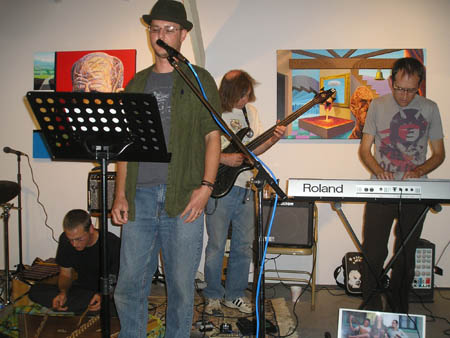


The open mic was inhabited by a fairly lengthy list of a few people who are beginning to form a fairly regular list of readers: David Iribarne, David Purdy, Adam Burrell, Jeff Norman, B. L. Kennedy, Lawrence D., and Frank Graham.

Litany came back for one last tune at the end while (what the hell) they still had everything set up. They did “The Final Reel” as an encore. Then everyone busily set about to tear down the set and look for the half-drunk beers that B.L. Kennedy had mysteriously strewn throughout the compound. Let’s call it the Fall Equinox version of an Easter Egg hunt.

Wednesday, September 17, 2008

September Literary Events

MONDAY, SEPTEMBER 1 - 7:30 p.m. - Poets Night at the Leger Hotel in Mokelumne Hill.

MONDAY, SEPTEMBER 1 - 7:30 p.m. - Comedic poets read at the SPC, 25th and R. Plus open mic. Free. 916-979-9706. http://www.sacramentopoetrycenter.org.

TUESDAY, SEPTEMBER 2 - 7-10 p.m. - Poetry slam/open mic at Sac City Pizza at Sutterville & 21st. http://www.myspace.com/lifesentenceshow

WEDNESDAY, SEPTEMBER 3 - 9 p.m. - Feature plus open mic (10:30 p.m.) at The Bistro, 3rd and F Streets in Davis, 1st and 3rd Wednesdays. Free. http://www.bistro33.com/bistro33_davis 530-756-4556 or aojones@ucdavis.edu

WEDNESDAY, SEPTEMBER 3 - 8 p.m. - Mahogany Urban Poetry Slam/Open Mic at Queen Shebas, 1704 Broadway. Your host: Malik Speaks.

THURSDAY, SEPTEMBER 4 - 8 p.m. - Features plus open mic. Poetry Unplugged at Luna's, 1414 16th Street. Free. http://www.lunascafe.com, 916-441-3931.

SATURDAY, SEPTEMBER 6 - 7 p.m. - RNR Music and Poetry - every first Saturday - Butch-N-Nellie's Coffee Company, 1827 I Street.

MONDAY, SEPTEMBER 8 - 7:30 p.m. - Terry O'Neal reads at the SPC, 25th and R. Plus open mic. Free. 916-979-9706. http://www.sacramentopoetrycenter.org.

TUESDAY, SEPTEMBER 9 - 7-10 p.m. - Poetry slam/open mic at Sac City Pizza at Sutterville & 21st. http://www.myspace.com/lifesentenceshow

WEDNESDAY, SEPTEMBER 10 - 8 p.m. - Mahogany Urban Poetry Slam/Open Mic at Queen Shebas, 1704 Broadway. Your host: Malik Speaks.

WEDNESDAY, SEPTEMBER 10 - 7:30 p.m. - Rattlesnake Press presents a new chapbook from Patrick Grizzell at The Book Collector, 1008 24th Street, between J & K Streets, 916-442-9295, richard@poems-for-all.com, http://www.sacfreepress.com/poems/

THURSDAY, SEPTEMBER 11 - 8 p.m. - Featured reader plus open mic. Poetry Unplugged at Luna's, 1414 16th Street. Free. http://www.lunascafe.com, 916-441-3931.

FRIDAY, SEPTEMBER 12 - 7-9 p.m. - Tim Kahl, Danyen Powell, Jordan Reynolds, Carol Louise Moon and Aaron Gerwer feature at The Second Friday Poetry Reading at The Vox (gallery & cafe), 19th & X Street, Sacramento, Free & Family-Friendly. Hosted by Cynthia Linville. Vegan meal pre- and post-show prepared by Caribbean Chef Kimba (served 6-10 pm). $10. info@voxsac.com

SATURDAY, SEPTEMBER 13 - 7:30 p.m. - Coleman Barks reads Rumi with Barry and Shelley Phillips. VETERANS MEMORIAL AUDITORIUM, Grass Valley, call 530-274-8384 ext 14 Noon-5, Tues-Sat for tickets. More info.

SUNDAY, SEPTEMBER 14 - 3-5 p.m. - Cleo Kocol features at the Lincoln Poets Club readings and open mic at the Willow Room, 12 Bridges Library, 485 12 Bridges Drive, Lincoln. Every Second Sunday. Contact 916-434-9226 or sjclark@psyber.com

MONDAY, SEPTEMBER 15 - 7:30 p.m. - Jim Nolt reads at the SPC, 25th and R. Plus open mic. Free. 916-979-9706. http://www.sacramentopoetrycenter.org.

TUESDAY, SEPTEMBER 16 - 7-10 p.m. - Poetry slam/open mic at Sac City Pizza at Sutterville & 21st. http://www.myspace.com/lifesentenceshow

TUESDAY, SEPTEMBER 16 - 6-8 p.m. - Reception for poet/artist Xico Gonzalez' exhibit, "Xicanismo" at the CSUS University Union Gallery (2nd floor). There will be a musical performance by The Storytellers (reggae/ska) and refreshments will be served. http://www.xicogonzalez.com

WEDNESDAY, SEPTEMBER 17 - 8 p.m. - Mahogany Urban Poetry Slam/Open Mic at Queen Shebas, 1704 Broadway. Your host: Malik Speaks.

WEDNESDAY, SEPTEMBER 17 - 9 p.m. - Feature plus open mic (10:30 p.m.) at The Bistro, 3rd and F Streets in Davis, 1st and 3rd Wednesdays. Free. http://www.bistro33.com/bistro33_davis 530-756-4556 or aojones@ucdavis.edu

THURSDAY, SEPTEMBER 18 - 8 p.m. - Featured reader plus open mic. Poetry Unplugged at Luna's, 1414 16th Street. Free. http://www.lunascafe.com, 916-441-3931.

FRIDAY, SEPTEMBER 19 - 7-8 p.m. - POETRY IN THE HILLS reading at Wild Mountain Books, 352 Main Street, Placerville. 530-622-4540. Free, Open Mic, contact piper@innercite.com

FRIDAY, SEPTEMBER 19 - 7:30 p.m. - All Spanish poetry reading--An Evening of Baroque Poetry, based on the poems of the Mexican nun: Sor Juana Inés de La Cruz. At La Raza Galeria Posada (1024 - 22nd Street, between K and J streets). Call 916-456-5323 for info. Admission is $5 ($3 for students and seniors). Presented by Los Escritores del Nuevo Sol. Plus open mic.

FRIDAY, SEPTEMBER 19 - James Lee Jobe is featured a The Other Voice, a poetry reading series sponsored by the Unitarian Universalist Church of Davis. The reading begins at 7:30 in the library of the church located at 27074 Patwin Road. Refreshments and Open Mike follow so bring along a poem or two to share. allegras@dcn.org.

SATURDAY, SEPTEMBER 20 - 6-9 p.m. - Music and Poetry Reading at Carol's Books, 1913 Del Paso Blvd. Every third Saturday.

SATURDAY, SEPTEMBER 20 - 7-9 p.m. - Underground Books Poetry Series at 2814 35th Street next to the Guild Theater. $3. Features plus open mic. Your host: Terry Moore. Call 737-3333 for more info. Every third Saturday.

MONDAY, SEPTEMBER 22 - 7:30 p.m. - Robert Grossklaus & Miles Miniacci with music by Litany read at the SPC, 25th and R. Free. 916-979-9706. http://www.sacramentopoetrycenter.org.

TUESDAY, SEPTEMBER 23 - 7-10 p.m. - Poetry slam/open mic at Sac City Pizza at Sutterville & 21st. http://www.myspace.com/lifesentenceshow

WEDNESDAY, SEPTEMBER 24 - 6-7 p.m. - Open Mic Poetry Nite at the Upstairs Art Gallery, Placerville. Every fourth Wednesday.

WEDNESDAY, SEPTEMBER 24 - 8 p.m. - Mahogany Urban Poetry Slam/Open Mic at Queen Shebas, 1704 Broadway. Your host: Malik Speaks.

THURSDAY, SEPTEMBER 25 - 8 p.m. - Featured reader plus open mic. Poetry Unplugged at Luna's, 1414 16th Street. Free. http://www.lunascafe.com, 916-441-3931.

SATURDAY, SEPTEMBER 27 - 4 p.m. - The Sacramento Poetry Center and the Zen Marxist Laundrettes invite you to the first complete reading of Emily Wright’s ten-part narrative poem, “love’s laundry.” Several poets will read parts of the poem in East Portal Park, at 51st and M Streets, in Sacramento. Featuring Sandra Senne, Laura Ann, Walton, Carolyn Schneider, Ellen Johnson, Patrick Grizzell and Cecile Martin. Bring a blanket or beach chair; refreshments will be served. Look for the reading on the M Street side of the park.

SATURDAY, SEPTEMBER 27 - 7-9 p.m. - The Show at the Wo'se Community Center, 2863 35th Street (off 35th and Broadway across from the parking lot). For vendor or event information please call T. Mo at (916) 208-POET. "The Show" is every last Saturday of the month. $5. This is a family event. "The BEST SHOW IN TOWN with an Open Mic, Top Notch Features and Live Band LSB." Sponsored by the FREEDOM EQUITY GROUP. http://mybmsf.com/bmsf/bmsf_peeps/peeps_poetry/wordouts_moore2.asp

SUNDAY, SEPTEMBER 28 - NOTE DATE CHANGE - 4:30 p.m. - Donald Sidney-Fryer: The Atlantis Fragments at The Book Collector. 1008 24th Street, between J & K Streets. 916.442.9295. http://www.sacfreepress.com/poems/

MONDAY, SEPTEMBER 29 - 7:30 p.m. - Alan Williamson and Andrea Zawinski read at the SPC, 25th and R. Free. 916-979-9706. http://www.sacramentopoetrycenter.org.

TUESDAY, SEPTEMBER 30 - 7-10 p.m. - Poetry slam/open mic at Sac City Pizza at Sutterville & 21st. http://www.myspace.com/lifesentenceshow

Thursday, September 11, 2008

2nd and 4th Saturday Poetry Workshops


Sacramento Poetry Center’s
2nd and 4th Saturday
Poetry Workshop

At South Natomas Community Center
next door to South Natomas Library
2921 Truxel Road, Sacramento, CA

Bring 10 copies of your one page poem!

Facilitated by Emmanuel Sigauke
and Frank Dixon Graham

contact or for info: grahampoet@aol.com

DIRECTIONS from Downtown Sacramento:
take I-5 North, then I-80 East to Truxel Exit
from exit, proceed South on Truxel, there’s a stop light at San Juan and Truxel – continue south on Truxel, pass San Juan Rd. – the Community Center is between San Juan and West El Camino on Truxel, (about one mile from the exit on I-80) at 2921 Truxel Rd.

http://www.sacramentopoetrycenter.org
http://sacramentopoetrycenter.blogspot.com

Saturday, August 30, 2008

SEP 28 | Poetry | Donald Sidney-Fryer | The Atlantis Fragments

poems-for-all presents

Sunday, September 28, 4:30pm
- - -
DONALD SIDNEY-FRYER : The Atlantis Fragments
- - -
The Book Collector
1008 24th Street
Between J and K Streets
in midtown Sacramento
916.442.9295
- - -
We're pleased to welcome Donald Sidney-Fryer back to Sacramento for a Sunday afternoon poetry reading where Donald will present his omnibus edition of the trilogy SONGS AND SONNETS ATLANTEAN.
- - -

"Mr. Fryer is a profound student of Clark Ashton Smith, and the influence shows, but he is very much his own poet, and he structures and plays with a surety and deftness which is remarkable."
-- Gahan Wilson

"Sidney-Fryer has created, in his fictional Atlantis, an entire civilization and a body of absorbing literature. The book should appeal to lovers of poetry, to devotees of science fiction, and to those who admire writers who can fashion a realistic world from the materials of mythology and speculation."
-- Earl J. Dias

"These poems are of an unearthly beauty. They celebrate love, beauty, and humanity; and yet throughout many of them is a consciousness of impending apocalypse. The imagery, lush, exotic, full of colors and magic names, is a welcome relief from the sterile, prosaic poetry of today. If you enjoy tripping on language, this book is for you. Whether the poems really are from the Atlantean or whether they are the creations of poet Sidney-Fryer, they deserve to be read and experienced."
-- Charles K. Wolfe

Donald Sidney-Fryer’s massive, 550-page poetry omnibus is the most elaborate book ever published by Hippocampus Press. Its color frontispiece, printed end papers, profusion of interior illustrations, Smythe sewn signatures and illustrated dust wrapper destine it to be a collector’s item. This hardcover omnibus presents the collected edition of the trilogy SONGS AND SONNETS ATLANTEAN in a limited edition of 300 copies.

Wednesday, August 27, 2008

ANN KENISTON and JUNE SARACENO August 25, 2008

Ann Keniston and June Saraceno showed up at the Sacramento Poetry Center on a hot August night on the same night as the beginning of the National Democratic Convention. There were plenty of open seats despite the seating area being a bit confined due to renovations. The office space is getting bigger.


Ann Keniston started the evening by reading from her book The Caution of Human Gestures with a poem “Booze”, that venerates the many forms of the intoxicating substance’s mood altering ability.

she scarcely notices she’s lost
first appetite, then thirst
for water, that she’s become
accident-prone, so
when at last she sees
her obligation to
what it’s made of her,
she feels unloosed, released.


The next poem she read was “Our Alliance” a poem about herself and her sister, who both relate to her mother’s reaction to the news that their father was remarrying by leaning on each other a little more heavily, but not too heavily.

“Bric-a-brac” starts out with a joke between two buddies about what heaven will be like. The poem then transforms into a reflection on the persistence of the lover’s body even when it is not immediately present.

“Persephone in Autumn” uses the voice of Persephone filtered through her “I” to arrive at the last stanza:

As if my love of sweetness
proves I know nothing
of bereavement, as if
I’ve gathered up
All the gold on earth to buy
What only confirms my poverty.


Read the full poem here

“Unwritten Poems” is written for all those gentle readers who will tolerate the miscues in all of the failed poems that don’t quite reach full blossom. In the poem Keniston imagines the fate of these failed poem.

And I like to imagine a reader
so distracted or naïve, she’s never heard
the confessional impulse is doomed

in contemporary literature or poetry
must be succinct and precise, who’s so eager
to locate her own Loss, History, Happiness

that she lifts the offered sheaf
and admires most what’s earnest, filled
with yearning, and flawed.


“The Bridge” is typical of several of Keniston’s poems in that it starts with a dream sequence and then follows up by considering it. The dream symbol of a bridge is used to reflect on the life with a lover and how love is often used as a hastily adopted tool to measure what it has given us.

“A Lesson” reflects on the persistence of the human will as seen in the scene of watching a baby trying to crawl forward even though it is invariably moving backwards.

“Second Language” peers in on a childhood episode where the speaker reflects on traveling in another country where one doesn’t speak the language, which is not all that different from journeying into the incomprehensibilities of love.

“Happiness” was the last piece from her book The Caution of Human Gestures

Happiness

It accomplishes no realignment
                of light on just-yellow
willow or pavement
          inflected toward late sun.
And the fugitive sparrown rise up in a clap
And turn and vanish, incising in air
                    a not-
visible shadowof their passage. Like Cezanne’s
black-rimmed peaches: the outline
              covered by that orange-pink
overlay, both pure form and
devoid of form. The happiness is
the underlayer. And the porous, blurred surface,
what we pass through, having risen
out of the subway and
          dispersed.


Keniston’s portion of the reading concluded with several new poems, “An Allegory,” an attempt to get the “I” out of the poem. She read two elegies for her mother, imaginging her still healthy in one and in the other imagining her mother’s grief. Fially, “Ars Poetica” concluded the evening for her.

[Note: Other Ann Keniston poems can be read here and here]


June Saraceno started her evening off with a poem she had written with her students as she gave them an assignment of write a poem about a fairy tale. The fairy tale that Saraceno wrote on was Hansel and Gretel, and the poem was called “Finding my Way Back.”

The next piece “Hand-me-Downs” was derived from her experience as a child in North Carolina where a car accident at the beginning of the poem eerily turns into a situation that exposes corruption and lust within the community where it happens.

“Remembering Tinky’s” was a poem that was written in memory of a dilapidated drinking establishment.

Finally, Saraceno read from what is shaping up to be her next manuscript of dramatic monologues. The piece she did was in the voice of Xantippe, the wife of Socrates. In it, Xantippe exacts revenge on Socrates’s depiction of her as a scold by turning the tables on him and casting him a a bit of a layabout bohemian.

Thanks both to Ann and June for making the trek across the Sierras to join us. I think I can speak for everyone at SPC there on the 25th that we truly appreciate your commitment to the practice and distribution of the art form.

Friday, August 01, 2008

Calendar of August Poetry Events

CAMILLE NORTON INTERVIEW by Lisa Jones follows this Calendar

CALENDAR COMPILED BY AARON GERWER

EMAIL AARON FOR CALENDAR ENTRIES AND UPDATES @ aarondscrub@yahoo.com

AUGUST Poetry Events!

Sat., 8/2 and every 1st Sat- Rhythm N Rhymes: open mike, webcast & filmed for public TV @ Butch N Nellie's, near corner of 19th & I

Mon, 8/4, 7:30 p.m. Mary Mackey and Brad Henderson, SPC HQ at 1719 25th st.

Tues, 8/5, 7:30 pm and every Tuesday: SPC Poets' Workshop @ the Hart Cntr, 27th/J sts. Danyen@ 530-756-6228 FREE bring 15 copies of your one page poem to be read/critiqued.

Every Tuesday 7 p.m. – “Go’s Open Mic” at Sac City Pizza, Sutterville at 21st across from Sac City College http://www.myspace.com/lifesentenceshow

Wed, 8/6 ; 8pm Mahogany Poetry Series, and every Wed night at Queen Sheba restaurant @ 1704 Broadway, with Khiry Malik M., Slam, open.

Wed, 8/7; eves, The Bistro, 3rd and F Streets in Davis, 1st and 3rd Wednesdays. Free. 530.756.4556 aojones@ucdavis.edu for info -- or schedule @
http://www.bistro33.com/bistro33_davis

Thurs, 8/8 and every Thurs 8pm, Open Mike and featured poet at Lunas Café -- Feature TBA

Mon, 8/11, 7:30 p.m. Brad Buchanan reads followed
by open mic. The SPC at 1719 25th street

Tues, 8/12, 7:30 pm and every Tuesday: SPC Poets' Workshop @ Hart Cntr, 27th/J sts. Danyen@ 530-756-6228 FREE bring 15 copies of your one page poem to be read/critiqued.

Friday, 8/15, Galleria Posada Featured Poet - Felicia Martinez. 1024 22nd St.Sac, www.larazagalleriaposada.org
Mon, 8/18, 7:30 pm. Nancy Wallace will be reading followed by an open mic. The SPC at 1719 25th street

Tues, 8/19, 7:30 pm and every Tuesday: SPC Poets' Workshop @ Hart Cntr, 27th/J sts. Danyen@ 530-756-6228 FREE bring 15 copies of your one page poem to be read/critiqued.

Wed. 8/20, 8pm, Mahogany Poetry Series, Queen Sheeba Restaurant, 1704 Broadway.

Thurs, 8/8 and every Thurs 8pm, Open Mike and featured poet at Lunas Café -- Feature TBA

Sunday, 8/24, 11-1pm, meeting of El Camino Poets bring 8 copies of your poems for critique. Hosted by Carol Louise Moon at the Hart Senior Center, 27th and J streets in Sac.

Monday 8/25, 7:30 p.m. Ann Keniston and June Saraceno read at SPC HQ 1719 25th St.

Tues, 8/26, 7:30 pm and every Tuesday: SPC Poets' Workshop @ Hart Cntr, 27th/J sts. Danyen@ 530-756-6228 FREE 15 copies of your one page poem.

Thursday, 8/28 8p.m. open mic and featured poets Ted Finn, and Gene Bloom at Luna's Cafe 1414 16th Street
Sac.

COMING SOON: Comedy in Poetry, Sept 1, 2008 at SPC HQ, with Carol Moon, Michael Rowe, Tim Kahl, Brad Buchanan and other very funny poets!

Alan Williamson and Adrena Zawinski – at SPC HQ,
September 29, 2008

Camille Norton Interview

Lisa Jones interviews Camille Norton
Parts One and Two

Part One:

Camille Norton's first book of poems, Corruption, was selected by Campbell McGrath as the winner of the 2004 National Poetry Series Open Competition. She has previously published poetry, fiction, and literary criticism in various journals and co-edited Resurgent: New Writings by Women (a collection of experimental writings).

Since Norton spent years studying Buddhism with a Zen master and continues meditation practice, it is not surprising that her poetry often focuses on the life of the mind, yet the manuscript beautifully balances the sensual and spiritual with the intellectual. Many of the poems in Corruption are ekphrastic (inspired by other art forms), some are very autobiographical, others focus on the historical time of the art she responds to.

Early influences for Norton were Yeats and Dickinson. One of her greatest current inspirations is the inventive mix of prose and poetry written by Anne Carson. She delights in reading challenging poetry such as Carson’s. When I said I found her work fairly accessible given its intellectual content, she explained that she decided early on that she wanted to be understood in her own writing.

Norton started writing poetry in high school and was active in the Boston poetry scene throughout her twenties. The eldest in a family of five, with a welder for a father, she had to make her own way to college and that included working in a factory and dropping out of two colleges, before she graduated from the University of Massachusetts, summa cum laud. She won the Grolier Prize in poetry and was granted a Steiger fellowship at Stanford, but chose Harvard instead, where she earned a Ph.D in English and American Literature and Language.
Norton currently teaches poetry as a full professor of English at the University of the Pacific in Stockton, California. I had the pleasure of studying with her a year ago, so I invited her to my home for what turned out to be a long and lively discussion.


The book has three sections. The first one is the title, Corruption, and the last one is “Songs against Ending.” In my mind these two topics seem to run through the whole book. I have heard you talk about this concept “Songs Against Ending”. I think you say we are trying to hold something in our hands, how do you put it?


I was just talking about this with an independent study student. We were reading a fabulous poem by Larry Levis, “Those Graves in Rome.” He tells the story of visiting Keats’ grave, about being young, going to Rome with a couple of friends and you know Keats doesn’t have his name on the grave. [The poem quotes the words Keats wrote for his tombstone “here lies one whose name is writ in water”].

He says in the poem that most everything we have disappears, and that’s really the truth. Inside the poem he talks about seeing a fingerprint on a bannister in Rome, made by a child . . . how this child could have died of malaria due to tremendous poverty. The mark is this fingerprint and he ends with a phrase like “names are both empty and full” and perhaps that’s “almost enough.”

What I was talking about with my student is--poetry is essentially just passed on person to person. Kind of like Buddhism--“from warm hand to warm hand” as they say. The rest of it--[there’s] so much we can’t hold onto.

I think that whole idea of corruption . . . this is a book I wrote after my father’s death. I had gone through all this stuff in my life. I had gone through a big break-up in a long relationship and I now see it as a working through of this passage--this is a mid-life book. I was really coping with “yes, I know about death and there’s just so much that is beautiful to look at here” and that is the challenge.

Speaking of which, I continue to just wrap my head about this in Buddhism, because there is something in Buddhism that is really unsatisfying to me about [what Buddhism says about] attachment. This whole business of how we just construct the self [from Buddhism] and it is not real--my reaction is “yes, but . . .”, “Yes, but this is what we do. So how about that part too? How about talking about being in the body?”

Are you saying “if Buddhism is telling me ‘don’t go for my pleasure here’ it must be wrong” ?

Well, . . . I don’t think it’s wrong. I think it has a deep, deep truth about what might be fundamentally true about the self. But the way it tells us how to deal with pain is to detach and that means you don’t attach to anything--you don’t attach to what you love--because everything causes suffering.

When I think about it, it is very odd. In some ways I am almost coming back to Christianity and the notion of a suffering Christ seems to represent something that speaks to me as an icon. I mean not that I am a Christian in any conventional sense, but I can really understand why it speaks so powerfully, because the suffering is embraced. It is embraced in a different way.

And when you wrote this book, you where embracing both the sadness and the pleasure, so something in addition to Buddhism was working for you.

I think that is why I like Italian art so much. This is what Italian art tells me--and what Western music tells me: “it can’t be all that bad if it produced art like that!” [laughs]

[laughing] Right.

[with laughter] Maybe it was worth all the corrupt popes and you know the cardinals and all that--to get that art out of it. And the music, the sculpture. You know--the body. I mean it is really something.

In Corruption you have a number of poems that are ekphrastic . . . they spring mostly from paintings and sculptures from the Renaissance which you observed while visiting Italy, right? Can you tell me more about how you discovered “I am going to do a bunch of poems from this method.”

Oh, it was total serendipity. I was on my sabbatical and I was invited to give some lectures in Florence, Italy on Western poetry. It was my first time in Italy and I was spellbound. . . . I found that it was a moment in my life that I had started to really clear the way for these poems. I was living in a loft and commuting and the art allowed me to think through certain problems.
I don’t know of any other way to say it, but for me probably one of my greatest pleasures is thinking, in a really concentrated form. That is what poetry is for me. Yes, it’s music, but it is thinking in a very focused way about language. Being able to look like that, again and again and again, to try and discover what it was that I was feeling.

Like in the poem “The Ideal City” that’s an anonymous painting and actually I only saw that in a book. I was so hit by it with this sense of grief, for the emptiness--the lack of the human body in this kind of perfect architectural drawing. But I felt so much sadness. I didn’t know I was going to write a poem about the death of my Zen master, but I think in that poem I was playing with some of these ideas about Buddhism. Emptiness is both positive and frightening . . . I started by just looking really hard at something, kind of trusting an intuitive response and trying to put my words to it. So that was the process.

I think the art really worked for me because I couldn’t write like--a Sharon Olds kind of poem. I just couldn’t. It was just too scary. I ended up writing --there’s material in there that’s often quasi-autobiographical, but also the voice is often very inflated or a persona. It is not this strictly confessional kind of poetry, but there is something in there that is true. That is more obvious in some poems than others.

In your poem “Judith and Holofernes” are you playing that up persona-like?

That’s a loosely autobiographical poem. . . . And it just came. It was channeled. I thought the book was finished. I was at an art colony and poems were just pouring through and that one came through and that was the poem that really pulled this book together for me.

So did you look that picture up on the internet?

Well I was reading about Caravaggio. That’s another thing that I do a lot--I steep myself in reading and research. So I thought “Hmm let’s do something about Caravaggio. . . . I got M, the Man who became Caravaggio, a fantastic biography and I just took out all of these books about his painting. I had seen some Caravaggio in Italy and I really thought and thought about him. It was a pretty amazing life that he had: homosexual, steeped in crime, all this underworld stuff, murder--probably for having an affair with one of his patron’s young valets. I looked at his paintings and it just came--the first poem--about John, the first person I was ever in love with: this whole sense of being young, that period of being 20, where there was so much pain. He was such a scoundrel.
...

I know you came from a working class family and then you went to Harvard. My sense of you is you have a deep love of the canon and . . . you have a feminist consciousness. So I think there’s something interesting about you--that you are an insider and an outsider at the same time? I am curious if you see that in your own writing or not?

I think I am an insider in poetry in that I know the genres and the conventions and the rules and I know about meter and form and I have read a lot of traditional poetry and still do. I would like to see people enter into this poetic conversation with . . . training. I think of myself that way . . . . I don’t know that I am that much of an outsider. Poetry is such a big, full world right now, but there’s always a question of who’s being read and who’s reading it.

[Yet you] are absolutely right--even in the way I teach--I use the canon to critique power, but I really love the canon. It is kind of like the way that I feel about Renaissance art, but you can also enter into the whole history of Renaissance art as a way of looking at the scandal of . . . religion.

So you are not going to be idealistic in your poetry about the classics.

No. But I love the forms and I am not interested in reproducing the same old tired sonnets, but there is something in the music of the language that I really believe in and that . . . gives me so much pleasure.
. . .

Part Two

You talked about [education as “salvation”] how [education or the life of the mind also] worked against you--you used it against yourself perhaps, as [in the Judith and Holofernes poem where you say “I studied detachment/read Sartre and Simone de Beauvoir in our bed./ All that wisdom and I wasn’t torn yet./I was learning to take it like a man/who parses Nietzsche between blow jobs/and lines of crystal meth.”]

I competed with men intellectually all the time and they didn’t like it. I started doing that in high school. I had a boyfriend break-up with me. He said “You use too many big words” and I said “What?” [laughing] Because I had been thinking “God, I am really dumbing it down for you! Because your so cute!” But education saved me from a chaotic family background.

I have to say the ten years of Catholic girls’ school--I had many beautiful moments there and then later when I went back to school. [Education] still is my salvation . . . . Very early on I found my footing in books and in the classrooms. . . . I could aspire to something and I could be seen in a way that I wasn’t seen at home . . .
.
So . . . there are poems about the body [in this book], but these poems are also about a mind that has been carrying a lot of ideas for a long time.

Well, corruption of the mind--is that the painfulness of being conscious and still caught in the world?

Corruption for me, means to be marked--it literally means decay. You don’t think of education as decay, you think of it as strengthening and growing. I think what Tim meant when he said that was: the education corrupted me, in terms of, it gave me lots of theories that were competing theories--too much information . . . Like in the poem “I Suppose They Call This Menopause, the Way I’m Flashing Off and On” [which continues “/with utterance. I have these several voices/I can’t repress, haggish voices without melody, long-/winded voices that carry on about choices/. . . . pursued the mind and found a place outside/the body, inside the mind-body split.]

I don’t think that learning decays the mind, but it certainly marks the mind in a way that you can’t go back to the unconscious.
. . .

In your own writing do you prefer poetry that is inspired by research as a way of getting away from the ego?

I think about the poets that have really just shaken me to the roots. I mentioned Phillip Larkin--you know this British conservative, writes in meter and wrote very sparsely--had a very bitter idea of humanity? He wrote this really famous poem called “This be the Verse.” It is very short and it begins “They fuck you up, your mom and dad, they do not mean to, but they do.”

[laughing] Oh, yes, I do know him.

No, I am drawn to all different kinds of poetry.

But I have heard you talk about wanting to get away from ego.

I don’t know if you can get away from ego, but I am interested in the way that language can create a different space for ego. In other words I am not interested in simply confessing my sins on paper or having a psycho-therapy session on paper. Although in fact these poems do all these things. They are psychoanalytic and confessional in a certain way, but poetry for me creates this other possibility for connecting to existence that is beyond purely the vanity of my own self.

This is really hard to talk about and maybe it is very vain of me to say this, but for me, I want to be in communication with other people who have written. That’s what really matters--to be inside this river of poems, going through this gate that happens. The way in almost seems like incantation. You go through the river, pass through the gate, and you have this experience and it is very deep. It is like going into dream.

So when you are in dream, it would be incorrect to say you’re just inhabiting your ego. Of course you are inhabiting your ego, but you are also in some sense . . . washing around in all of the stuff that this culture produces and what it means to be human. Human--knowing that you are born, you are young, you are aging, and you are going to pass away. What stays behind is this river of the things we love . . . and, for me, it is language.
. . .

Once you said you thought your audience was feminism, but that you realized it was something else. I don’t know if that is correct, but who is your audience and how has it changed over time?

Actually as a young feminist, I almost went completely silent. . . . I struggled so much in my 20’s because feminism at that time, like Marxism, privileged certain kinds of experience. I didn’t have the words to say that people were reading for concepts instead of language.

[Norton explained later, off-tape, that Ann Carson’s writing was transformational for her. Carson’s work helped her see she could break from expected form and write as she wanted to.]

. . . I write for people like myself. I actually write for myself. I don’t even know who I write for anymore, but I know that my poetry changed, when I started writing the poetry I wanted to read. That’s basically what happened.

Lisa Jones is a staff interviewer for Poetry Now. She recently won first place for the Constance Topping Memorial Prize for poetry and received an honorable mention in the Sacramento Poetry Center contest. She can be reached at lisajonespoet@gmail.com.